
Something's off with your system—you can tell that much, but nobody's explained what in terms that actually make sense. That gap is where Joe's Heating & Air Repair does its best work, handling heat pump repair throughout Surf City, NC, and nearby areas with an explanation you'll understand attached to every finding. Equipment along this coast runs close to year-round and sits in salt air the whole time, which means small issues develop faster here than most homeowners expect. Catching them early keeps a Tuesday inconvenience from turning into an August emergency.
Joe's Heating & Air Repair is a local HVAC contractor based in Surf City, NC, serving homeowners across Topsail Island, Pender County, and the greater Wilmington area. Keeping existing residential heat pumps running well accounts for a large share of our daily work, covering diagnostics, and repairs on both the heating and cooling sides. Every technician on our team holds EPA 608 certification, and standard repair work comes with a 30-day warranty.
Systems rarely quit without warning. Usually there's a stretch of weeks where the airflow seems a little weak, the unit runs longer than it used to, or a faint noise shows up that you stop noticing after a few days. Then a heat wave arrives, and the whole thing gives out on the hottest afternoon of the year.
What's happening underneath is wear that's been accumulating quietly. Dirty coils force the system to work harder for the same result. A capacitor slowly loses its charge until it can't start the compressor. Condensate drains clog with algae in humid weather, and corrosion affects outdoor components sitting a few blocks from the ocean. None of these announce themselves loudly, and each one puts extra strain on parts that cost real money to replace.
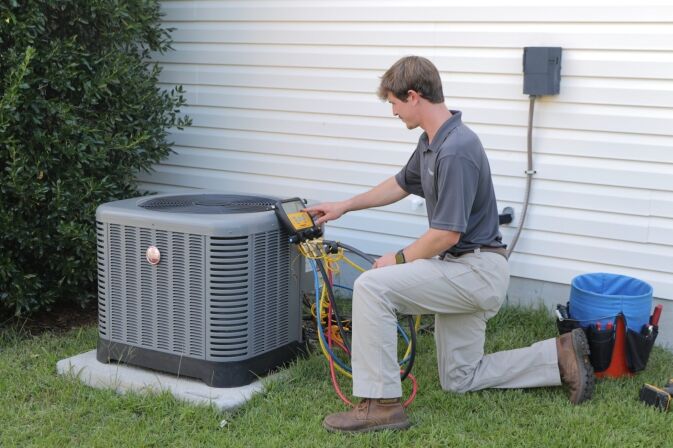
Our service visits are built to catch that. Technicians inspect the refrigerant system, check airflow, test electrical connections and components under load, clear and verify condensate removal, evaluate overall operation, and look at filter condition. Anything we find gets explained to you in plain language along with what it'll take to address it, and you decide from there. Heat pump repair work follows the same approach, starting with a full diagnosis rather than swapping parts and hoping.
The payoff is a system that makes it through the season without drama. Equipment that's cleaned and adjusted uses less electricity, holds temperature more evenly, and lasts closer to the years it was built for. You also get a written report of everything we checked, so there's a record of your system's condition over time.
Here's what a service call with us actually covers.

Figuring out the real cause takes testing rather than guessing, and that's where most of our time goes on a service call. Electrical components are checked under load, refrigerant pressures are measured against the system's expected output, and airflow is verified before anyone reaches for a part. You'll hear exactly what failed and why it failed before any work begins.
Heat pumps handle both seasons, which means twice as many run hours and twice as many opportunities for something to go sideways. Our heat pump repairs cover the full range, from a unit blowing cold air in January to one that won't cool at all in July. Common repairs are backed by a 30-day warranty, and manufacturer coverage is honored on anything still under it.
Not every call involves a system that's stopped working. Uneven rooms, lingering humidity, short cycling, and bills that climb without explanation all point to something worth investigating. Tracking those down sometimes leads back to ductwork or sizing rather than the equipment itself, and we'll tell you when that's the case.
Checking the system before summer and again before winter puts you ahead of the two stretches when equipment works hardest. Our heat pump maintenance service covers both heating and cooling, since a unit that cools beautifully in June can still struggle to heat in December. Scheduling ahead of the busy season also means shorter wait times for appointments.
Getting the size right is the whole ballgame, because a unit that's too big cools the air without removing enough humidity, leaving the house feeling clammy. Our heat pump installation process includes a load calculation for this reason, which tells us what the home actually needs rather than what a rule of thumb suggests.
Deciding when to pull the trigger is the hard part, so here's a rough guide: repairs that keep coming back, refrigerant that has to be added every season, and a unit past its warranty all point in the same direction. Heat pump replacement makes sense once you're spending real money to keep something limping along, though we'll never push you there before you're ready.
Line-set routing is one of those details nobody thinks about until it's done badly and there's copper stapled across the front of the house. We plan a mini-split installation with as much focus on how the finished job will look as on how it will perform, keeping runs tidy and penetrations sealed against coastal weather.
Blower wheels on ductless units collect dust and moisture over time, and that buildup is usually behind the smell people notice when the system starts up. Proper Mini-Split Repair means actually cleaning those components, not just spraying something on the filter and calling it done.
Homeowners often assume a bigger system means better performance, and it's one of the more expensive misconceptions out there. We approach HVAC Installation by matching capacity to the house, then verifying our work with startup testing so nobody has to take it on faith.
A system that cycles on and off every few minutes is telling you something, and so is one that runs constantly without ever satisfying the thermostat. Those symptoms both fall under HVAC Repair and Maintenance, and the cause could be anything from a dirty coil to a control problem to improperly sized equipment.
Every remodel has a point where mechanical decisions get locked in, and once framing is closed up, your options narrow fast. HVAC renovations go more smoothly when heating and cooling are part of the conversation early on, because that's when ductwork, equipment placement, and return air can still be adjusted.
Customers stay with us for reasons that have nothing to do with advertising.
Anyone handling refrigerant needs EPA 608 certification, and our whole team holds it along with the field experience to diagnose problems correctly the first time.
Running a family business here means we'll see you at the grocery store, which is a pretty strong incentive to do the job right.
Repairs carry 30 days of coverage, qualifying installations include a one-year labor warranty and access to a one-year quarterly monitoring program, and manufacturer warranties are fully supported.
Anyone new to us receives 10% off their first service.
Working with Amana, Daikin, and Goodman equipment keeps parts available and repairs moving without long waits.
Because a heat pump operates in both heating and cooling seasons, regular service helps catch developing problems before they require larger repairs. Many homeowners schedule maintenance in spring and fall so the system gets checked before periods of heavier use.
Several issues can reduce heat pump performance, including restricted airflow, dirty components, electrical problems, refrigerant issues, thermostat problems, or worn parts. Heat Pump Repair start with diagnosing the actual cause rather than guessing based on a single symptom.
Routine heat pump maintenance commonly includes checking airflow, electrical components, refrigerant operation, condensate drainage, filters, controls, and overall system performance. Keeping the outdoor equipment clear of debris and changing or cleaning filters as recommended can also help between professional visits.
Call for heat pump repair when you notice weak airflow, unusual sounds, repeated cycling, poor temperature control, unexpected increases in energy use, or a system that won't operate normally. Addressing a noticeable change early may prevent a minor issue from placing additional strain on other components.
Outdoor HVAC equipment near the coast is exposed to humidity, moisture, airborne salt, and other environmental factors that can contribute to corrosion and buildup. Regular Heat Pump Repair allow a technician to inspect the system and address developing performance issues before heavy seasonal use.
FAQs reviewed by Joe Dubois, owner of Joe's Heating & Air Repair, a certified HVAC contractor in North Carolina.
A little attention now costs a lot less than a breakdown in the middle of summer or winter. Reach Joe's Heating & Air Repair to get on our schedule.
Business Name: Joe's Heating & Air Repair
Address: Surf City, NC, 28445
Phone: 910-619-0335
Business Hours:
Mon - Fri: 7:30 AM –5:00 PM
Sat-Sun: Closed
10% Off for New Customers
30-day warranty on standard repair work
Manufacturer warranties honored
One-year labor warranty on qualifying installations
10-year parts warranty on qualifying installations
One-year quarterly monitoring program available
Installation reports are provided with new installations
