
Almost every house has that one room nobody wants to be in, whether it's the sunroom that bakes by noon or the bonus space over the garage that never quite catches up. Joe's Heating & Air Repair handles mini-split installations in Surf City, NC, and nearby areas, and it's usually the cleanest fix for spaces the main system was never designed to reach. Running new duct through an existing house gets expensive fast, especially in older coastal homes with plaster walls and tight framing. A ductless setup skips that entirely and gives the room its own thermostat.
Joe's Heating & Air Repair is a licensed and insured HVAC contractor headquartered in Surf City, NC. Ductless heating and cooling make up a meaningful part of our residential work, covering single-zone systems for one room and multi-zone setups that condition several spaces from a single outdoor unit. Our company launched in 2022, and our technicians hold EPA 608 certification.
Homeowners describe it the same way pretty consistently. One space in the house sits five or 10 degrees off from everywhere else, so the family avoids it half the year, and cranking the thermostat to compensate just makes the rest of the house uncomfortable while the power bill climbs.
The cause is usually structural rather than mechanical. Additions and converted spaces often got tied into ductwork already sized for the original square footage, so airflow to the new area was limited from the start. Older homes sometimes have no ductwork at all in certain sections, and rooms with lots of glass or western exposure heat up faster than a central system can remove the heat. Asking one piece of equipment to handle all of that rarely works.
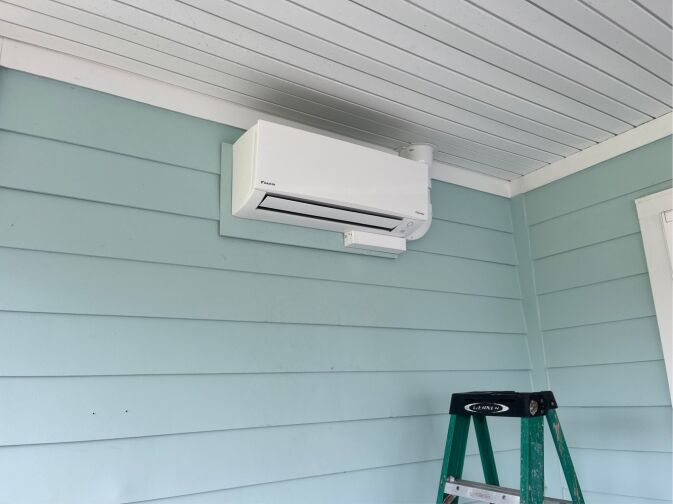
Going ductless solves it by treating the problem area separately. We evaluate the space, calculate what it actually needs, then place an indoor head where it'll move air well and route the line set to the outdoor unit through a hole about three inches across. A ductless installation requires almost no demolition, which is why it works so well in finished spaces. Placement, condensate drainage, and clean line-set routing are planned before anyone drills, since these details determine both performance and the finished job's appearance.
Once it's running, the room maintains the temperature you set without dragging the rest of the house along. Your central system stops overworking, energy use drops because you're only conditioning the space in use, and a ductless AC setup runs quietly enough that most people forget it's on. Every installation concludes with startup testing and a written report detailing the system's performance.
Here's a quick look at where these systems fit and how we handle them.

Ductless equipment uses inverter-driven compressors that adjust output continuously rather than switching fully on and off. Longer, gentler run cycles hold temperature steadier and pull more humidity out of the air, which counts for a lot along the coast. Losses through leaky ductwork disappear entirely, so more of what you pay for reaches the room.
Sunrooms, home offices, workshops, and bedrooms that never match the rest of the house are all good candidates. A mini-split heating unit works in both directions, so the same equipment that cools in August handles the cold snaps in January. Setting one room warmer or cooler than the others also tends to settle a few household disagreements.
Plenty of houses around here were built before central systems were standard, and adding ductwork means opening up walls and ceilings that nobody wants disturbed. Ductless HVAC gets around that with minimal impact on the structure or the finishes. Historic and coastal cottages are common projects for us, and we take care to keep exterior runs tidy and sealed against the weather.
New square footage almost always outpaces the capacity of the original equipment. Putting a mini-split AC unit in the addition preserves comfort in the rest of the house, rather than stretching a single system beyond its limits. Bringing us in while plans are still being drawn gives us room to work out placement before the walls close up.
One indoor head paired with one outdoor unit covers a single room simply and affordably. Multi-zone configurations run several heads off one condenser, each with its own control, which suits whole-home ductless mini-split installation or a few problem areas at once. Deciding between them comes down to how many spaces you're conditioning and how you actually use them.
Some houses skip central equipment altogether and run entirely on multiple heads. Full ductless cooling and heating setups work particularly well in smaller homes, vacation properties, and places where ducts can't be routed. Load calculations guide how many zones the home needs and where each one belongs.
Home renovations can change how air moves through a space, especially in older homes, additions, and remodeled rooms. We handle HVAC renovations by working within the existing structure, updating outdated equipment or ductwork, and designing solutions tailored to the home's new layout.
Homeowners around here have plenty of options, so here's what tips the scales in our favor.
Every technician on our team is EPA 608 certified, which matters for ductless work, where refrigerant lines are charged and connected on-site.
We're family-run and rooted in this community, which means our name is attached to every job we finish.
Coverage runs for 30 days on standard repairs and a full year of labor on qualifying installations, with an available one-year quarterly monitoring program and manufacturer warranties honored throughout.
A 10% discount applies to your first service with us.
Daikin builds some of the best ductless equipment made, and we install their systems alongside Amana and Goodman.
Yes, a properly designed multi-zone ductless system can heat and cool multiple areas of a home, while a single-zone system serves one specific space. Whether a whole-home mini-split installation makes sense depends on the home's layout, heating and cooling demands, and the number of zones required.
No. A ductless mini-split moves conditioned air directly into the room or zone, so it doesn't depend on a traditional central duct system. That makes a mini-split installation useful for older homes, additions, converted spaces, and rooms where adding new ductwork would be difficult.
An HVAC contractor should consider room size, insulation, windows, ceiling height, sun exposure, occupancy, and other factors that affect heating and cooling demand. Choosing equipment based only on square footage can result in a system that doesn't operate as effectively as it should.
A typical mini-split installation includes mounting the indoor and outdoor units, running the refrigerant lines and drainage lines, making the necessary electrical connections, and testing the finished system. Multi-zone projects require additional planning because several indoor units connect to the overall ductless HVAC setup.
Mini-splits work well in additions, garages, bonus rooms, renovated spaces, older homes without ductwork, and rooms that need separate temperature control. They can also provide a flexible ductless heating and cooling option when extending an existing central HVAC system isn't practical.
FAQs reviewed by Joe Dubois, owner of Joe's Heating & Air Repair, a certified HVAC contractor in North Carolina.
There's no reason to write off a space in your own house because the temperature never cooperates. Call us, and we'll look at what it'd take.
Business Name: Joe's Heating & Air Repair
Address: Surf City, NC, 28445
Phone: 910-619-0335
Business Hours:
Mon - Fri: 7:30 AM –5:00 PM
Sat-Sun: Closed
10% Off for New Customers
30-day warranty on standard repair work
Manufacturer warranties honored
One-year labor warranty on qualifying installations
10-year parts warranty on qualifying installations
One-year quarterly monitoring program available
Installation reports are provided with new installations
